













Free time tracking software: what's actually free in 2026

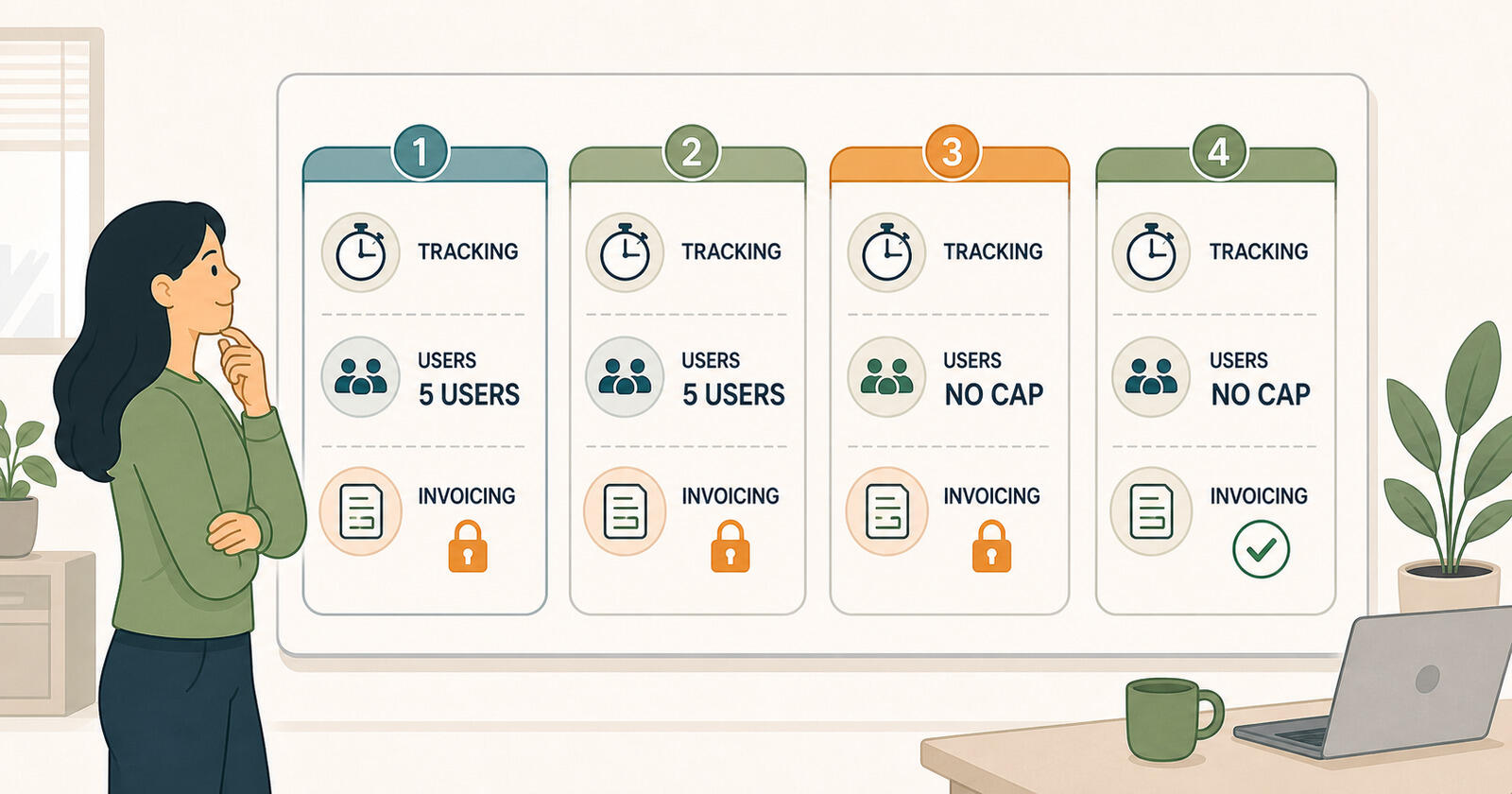
Free time tracking plans differ most in team size, billing and exports. Toggl and Clockify both give you unlimited time entries and projects on free, capped at 3 people on Toggl and 5 on Clockify, then require a paid plan for more users or billable rates. Jibble keeps users unlimited but never turns hours into invoices. Timen is free with no cap and includes invoicing. Compare the free plan with the work you need to do: recording hours, preparing reports or invoicing clients.
What does free actually mean in a time tracker?
Free almost always means the tracking is unlimited and something else is not. That is the pattern across the whole category, and once you see it the pricing pages get much easier to read.
Vendors give away unlimited time entries, projects, and clients because those cost them almost nothing and they are what gets you in the door. What they hold back falls into three buckets: seats, billing, and oversight. Seats are the most common limit, usually five. Billing means rates, invoicing, and anything that attaches a number in currency to an hour. Oversight means approvals, locked entries, audit logs, and scheduled reports - the features a manager wants and an individual does not.
This matters because the free plans are not really competing on how much they give away. They are competing on where they draw the line, and the right tool is the one whose line sits past your needs rather than in front of them.
The shape is not unique to time tracking. Free tiers across adjacent software categories trade the same way, and the real cost tends to show up as setup effort, workarounds for missing features, and the adoption problems that follow rather than on the invoice - which is the argument made about free project management tools too. Recognising the shape is more useful than memorising any one vendor's limits, because the limits change and the shape does not.
Free time tracking software compared
Here is where each free plan stops. Prices are the entry paid tier, since that is what you pay the moment the free plan runs out.
| Tool | Free users | Billing on free | First paid tier | Best free fit |
|---|---|---|---|---|
| Toggl Track | Up to 5 | No rates, no invoicing | 9 dollars per user | Solo and small teams tracking for insight |
| Clockify | Up to 5 | No rates, no invoicing | 3.99 dollars per user annually | Teams who want the cheapest upgrade path |
| Jibble | Unlimited | Never invoices, any tier | Paid tiers add GPS and PTO | Shift teams clocking in and out |
| RescueTime (Lite) | 1 | No, not a billing tool | 7 dollars per month annually | Personal focus and productivity tracking |
| Timen | Unlimited | Rates and invoicing included | No paid tier | Client work where hours become invoices |
The column that decides most choices is the third one. Everything else is a matter of degree, but billing is usually a yes or no.
Why do free plans stop at 5 users?
Five is the number where a tool stops being a personal habit and starts being company infrastructure, and that is the point vendors want to start charging. It is not arbitrary - below five you are usually a freelancer or a founding team, and above it someone is managing the workspace rather than just using it.
The practical trap is that the cap counts everyone in the workspace, not everyone tracking time. The founder who never runs a timer, the bookkeeper who only opens reports once a month, the contractor you added for one project - all seats. Teams routinely hit five with three people actually tracking.
The jump is also not gentle. There is no six-seat tier at a small premium; you move to the paid plan and pay per seat for every seat, including the ones that used to be free. On Toggl Track, a five-person team adding one contractor goes from nothing to 54 dollars a month. Clockify softens this considerably - its Basic tier starts at 3.99 per user on annual billing, so the same move costs about 24. If you expect to cross five soon, comparing the upgrade price matters more than comparing the free plans.
Why is invoicing almost never free?
Because it is the feature that proves the tool is making you money, and that is the easiest thing to charge for. A time tracker that tells you where your week went is nice to have. A time tracker that turns Tuesday afternoon into a line on an invoice has an obvious return, and vendors price accordingly.
The result is a genuinely awkward gap for freelancers and small agencies, who are the people most likely to need billing and least likely to have a budget for it. On Toggl Track you need Starter at 9 dollars per user before an hour can carry a rate. On Clockify, rates arrive at Basic and invoicing not until Standard, which is a second upgrade. Jibble does not invoice at any price, so no amount of spending fixes it there.
This is the specific gap Timen was built around - billable hours and invoicing are in the free product rather than behind a tier. That is a real trade rather than a free lunch: there is no profitability analysis, no timesheet approval workflow, and no audit log, because those are the features being skipped to keep the billing side free. For a freelancer or a small agency that mostly needs hours to become invoices, that trade usually lands the right way. For an operations manager who needs approvals before anything is billable, it does not.
Is it really free, or a trial in disguise?
Genuinely free, in almost every case here. Toggl Track, Clockify, Jibble, and Timen all have permanent free tiers with no card required and no expiry date. You are not on a countdown.
What causes the confusion is that new accounts usually start on a trial of the paid features. For 30 days you have rates, approvals, and saved reports, and then those quietly vanish and you land on the actual free plan. Nothing is deleted and nothing breaks, but the product visibly shrinks, and people reasonably read that as the free version ending. It is worth knowing which features you are testing during that first month, because half of them may not be there in month two.
RescueTime is the one worth reading twice. Its free Lite plan still exists and still does automatic tracking, but it is not shown on the pricing page at all - you only find it mentioned in the help centre and in a note about what happens when you cancel. Free but unadvertised is a different thing from discontinued, and a lot of RescueTime alternative roundups get that wrong.
Two others are worth checking individually before you commit, because both changed recently. Clockify's free plan dropped from unlimited users to 5 in 2026, which caught out a lot of teams who picked it for exactly that reason. And Jibble really is free for unlimited users, but the marketing line describes the attendance timer rather than the whole product.
Which free time tracker should you choose?
Work out which limit you hit first, then pick the tool whose free plan sits past it.
- Tracking for insight, small team: Toggl Track. The free tier is the most complete on the tracking side, with the autotracker and idle detection included.
- Expect to pass 5 people soon: Clockify. The free plans are similar, but the upgrade costs less than half as much per seat.
- Shift work and attendance: Jibble. Unlimited free users and kiosk clock-in, as long as you do not need invoices.
- Personal focus tracking: RescueTime Lite, remembering it holds only two weeks of history and one goal.
- Client work that gets invoiced: Timen, or budget for a paid tier elsewhere from the start.
Freelancers have a narrower choice than the list suggests, because billing is usually non-negotiable and it is the first thing every free plan removes - the freelance tool comparison weighs the nine main options on that basis.
If you are choosing between the two obvious options, Toggl and Clockify is the comparison most people are actually running, and the free plans are closer than the paid ones.
FAQ
- What is the best free time tracking software?
- It depends on which limit you hit first. Toggl and Clockify both give strong free tracking, capped at 3 users on Toggl and 5 on Clockify, but paywall billable rates and invoicing. Jibble keeps unlimited users free but is an attendance tool and does not invoice. Timen is free with no user cap and includes billable hours and invoicing. Pick by whether your constraint is team size, billing, or advanced reporting.
- Is free time tracking software actually free, or a trial?
- Most of the well-known ones are genuinely free forever, not trials - Toggl Track, Clockify, Jibble, and Timen all have permanent free tiers with no credit card. The common confusion is that new accounts often get a 30-day trial of the paid features first, so the product appears to shrink when the trial ends and you land on the real free plan.
- Can you invoice clients with free time tracking software?
- Rarely. Billing is the feature most free plans hold back, because it is what businesses will pay for. Toggl Track and Clockify both put billable rates and invoicing on paid tiers, and Jibble does not invoice at any tier. If turning tracked hours into invoices is the reason you are tracking, check that specific feature before choosing.
- Is there free time tracking software with no user limit?
- Yes, but not many. Jibble and Timen both allow unlimited users on their free plans. Most others, including Toggl Track and Clockify, cap free at 5, and the cap counts everyone in the workspace rather than only the people running timers.
- Do free time trackers keep your data if you never upgrade?
- Yes on all the tools here, though export options vary. Toggl Track and Clockify both allow CSV export on their free plans, so your history stays portable if you switch later.
The short version
Free time tracking software is mostly real, mostly permanent, and mostly shaped the same way: unlimited tracking, five users, no billing. The differences that matter are how quickly you will hit the seat cap and whether you need hours to become invoices.
Answer those two questions before comparing feature lists, because they eliminate most of the options immediately. A solo freelancer tracking fixed-fee work has a genuinely free choice among all of these. A five-person agency that invoices hourly has almost none, and is better off knowing that up front than discovering it on the day an invoice is due.
Timen is free with no user cap and invoicing included, if the billing side is the limit you were going to hit.