












Timen vs Harvest: which tool is better?
Choose Timen if you want the lighter client-work workflow for tracking, review, reporting, and invoicing. Choose Harvest if your team lives in billable rates, budgets, and invoice-ready client operations every week.
Timen and Harvest both help teams turn tracked time into something usable, but they are built around different levels of billing complexity. Timen is better when you want client-ready invoicing without making the whole product feel like an agency back office. Harvest is better when billing is not just an output, but the center of the product decision.
That usually means small consultancies and freelancers who want less operational drag lean toward Timen. Agencies and service teams with tighter budget, rate, and invoice discipline often still prefer Harvest because the billing posture is stronger and more explicit.
Which is better: Timen or Harvest?
Timen is better for smaller service teams that want client-ready billing without carrying a heavy agency back office. Harvest is better for agencies and consultancies where budgets, rates, and invoice discipline shape the whole workflow.
Choose Timen if you want lighter operations. Choose Harvest if billing structure is the main product decision.
Quick decision
Choose Timen if:
- You want tracked time, calendar review, reports, and invoicing in a lighter workflow.
- You care more about everyday usability than billing structure depth.
- You want a tool that is completely free instead of a product that feels centered on agency finance.
Choose Harvest if:
- You bill clients regularly and want rates, budgets, and invoices to sit at the center of the product.
- You want tracked hours to flow directly into a strong agency-style billing routine.
- You are comfortable with a product that feels more billing-led than tracking-led.
Biggest difference: Harvest is stronger when billing drives the whole workflow, while Timen is stronger when you want billing support without carrying around a heavier agency operating layer.
At a glance: Timen vs Harvest
This table is most useful if your shortlist comes down to light client tracking versus billing-first operations.
| Category | Timen | Harvest |
|---|---|---|
| Best for | Teams that want client-friendly tracking without a heavy billing posture | Agencies and consultancies with billable work at the center |
| Core approach | Simple tracking plus review, reports, and invoicing | Time tracking tied tightly to budgets, rates, and invoices |
| Main strength | Lighter everyday workflow | Stronger billing-first structure |
| Main tradeoff | Less mature for teams with deeper budget controls | Heavier if billing is not your main concern |
| Better fit | Freelancers and small service teams | Agencies with recurring invoice and budget discipline |
Does billing need to drive the whole workflow?
Harvest is better for teams whose billing model drives the whole workflow. It is more opinionated about the relationship between tracked hours, billable rates, budgets, and invoices, which is exactly what many agencies want.
Timen is better for teams that still bill clients but want lighter operations. It still covers invoicing and reporting, but it does not make the rest of the product feel like a billing system first and a tracker second.
Which tool feels lighter in daily use?
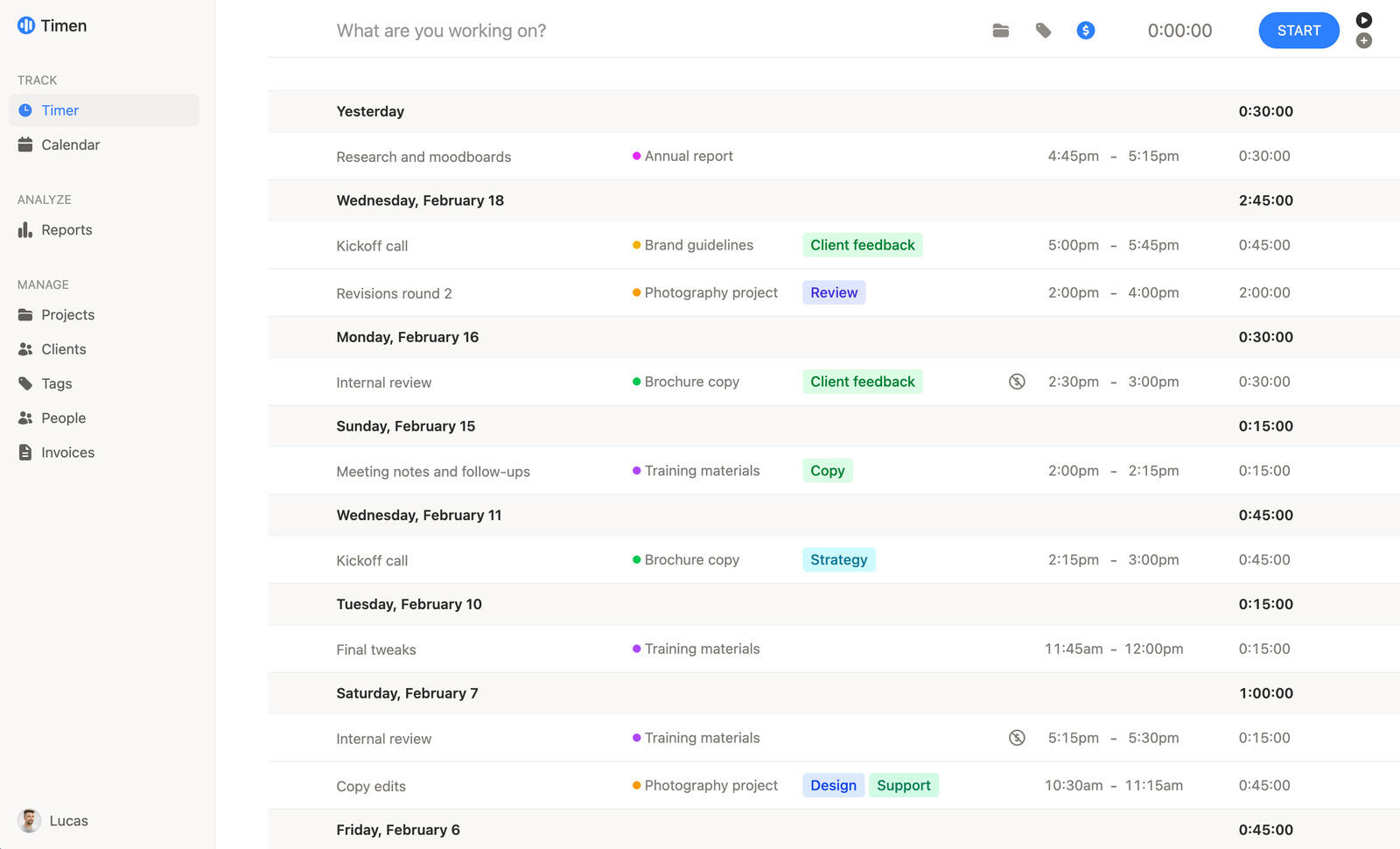
Timen is better for most teams that want lighter daily use. The tracking flow is more direct, and the follow-through around review and reporting feels more natural if the team wants less operational overhead.
Harvest is better for teams that already think in billable structure all day. That is not a flaw when the team actually works that way, but it becomes a tradeoff when the team mostly wants clean tracking and occasional billing instead of a stronger finance posture.
A freelancer juggling three active clients is a good example. If they invoice often but still want the product to stay simple, Timen is the easier fit. If they manage retainers, budgets, rates, and regular invoice cycles every week, Harvest starts looking more justified.
Who should choose Timen and who should choose Harvest?
Timen is better for smaller service teams, freelancers, and consultants who want to move tracked time through review time in context without the product feeling heavy. Harvest is better for agencies and billable teams that want tracked time to flow through budgets and invoicing with fewer compromises.
This is one of the clearest team-type splits in time tracking. Timen is about simplicity with enough follow-through. Harvest is about stronger billing structure, even when that makes the workflow narrower.
How does pricing compare?
The practical difference is not just seat cost. It is whether you want everything included completely free or a billing-first product whose price is easiest to justify when billable work is core to the business.
| Pricing point | Timen | Harvest |
|---|---|---|
| Free plan / trial | Free for everyone | Free for 1 seat and 2 projects |
| Next pricing level | Free — all features included | Teams from $9 per seat/month billed annually, or $11 monthly |
| Upgrade trigger | None — every feature is already included for free | Moving from limited free use into regular client billing and project structure |
| Best budget fit | Teams that want full features immediately, completely free | Teams that monetize time strongly enough to justify the billing posture |
The buyer who cares most about this difference is the client-service team asking whether billing strength or workflow simplicity creates more value. If billing rigor already drives the business, Harvest is easier to defend. If the team wants less friction around everyday use, Timen is easier to live with.
Strengths and tradeoffs
This decision is mostly about how billing-centered you want the product to be.
Timen
- Simple daily workflow that still supports review and invoicing.
- Completely free keeps the pricing logic straightforward.
- Better fit when billing matters, but not enough to dominate the product.
Main tradeoff: Timen is the weaker fit if your team needs deeper budget discipline, more mature billing expectations, or a product that feels explicitly built for agency finance workflows.
Harvest
- Strong billable time, budget, and invoice flow.
- Good fit for service businesses that monetize tracked hours directly.
- Approachable for teams that already think in billing terms.
Main tradeoff: Harvest is the weaker fit if the team wants a lighter everyday tracker and only occasional billing, because the product still pulls the workflow toward agency-style structure. This tradeoff shifts again when the blocker is not missing features but confidence in Harvest.
Common questions about Timen vs Harvest
These are the questions buyers usually ask when the shortlist is down to Timen and Harvest.
- Is Timen better than Harvest?
- Timen is better when you want simpler tracking with enough reporting and invoicing built in. Harvest is better when budgets, rates, and invoices are the main reason you are paying for the tool.
- Which tool is easier to use, Timen or Harvest?
- Timen is easier for teams that want less operational overhead. Harvest is easier for teams that already run a billing-heavy client workflow and want the product aligned to that reality.
- Which tool is cheaper, Timen or Harvest?
- Timen is completely free, with all features included. Harvest has a limited free option and a more billing-centered workflow, with Teams pricing once you move past free use.
- Should an agency choose Timen or Harvest?
- Choose Harvest if the agency runs tightly on billable rates, budgets, and regular invoicing. Choose Timen if the agency wants to keep client billing simpler and the daily tracking experience lighter.
Final decision
Choose Timen if you want client-friendly time tracking without buying into a more billing-heavy product than you need. Choose Harvest if the business runs on budgets, billable rates, and invoice discipline every week. The better tool is the one that matches how central billing really is to your workflow.
To keep comparing inside the Timen cluster, see how a timer-first option changes the decision in Timen vs Toggl Track, compare the lower-cost rollout angle in Timen vs Clockify, or look at Timen's invoicing workflow.
Try Timen if you want to test whether a lighter workflow is enough for your client work before moving deeper into a billing-first stack.