












Timen vs Clockify: which tool is better?
Choose Timen if you want a cleaner workflow with calendar review, reports, and invoicing already built in. Choose Clockify if you want the strongest free-plan rollout and more admin-oriented controls at a lower starting cost.
Timen and Clockify solve different problems for buyers who think they are shopping for the same thing. Timen is aimed at making everyday time tracking calmer and easier to follow through on. Clockify is aimed at giving teams broad coverage, lots of controls, and a lower-cost path to rolling time tracking out across more people.
So this comparison is not really about feature count. It is about what kind of friction you want less of. If you want a smoother daily routine built around direct tracking, Timen is usually the better fit. If you want cheaper team-wide adoption and more admin levers, Clockify usually wins.
Which is better: Timen or Clockify?
Timen is better for small teams that want the cleaner day-to-day workflow. Clockify is better for organizations that care most about free rollout, lower seat cost, and broader admin coverage.
Choose Timen if workflow quality matters more than policy depth. Choose Clockify if budget and scale matter more than product feel.
Quick decision
Choose Timen if:
- You want time tracking to feel calm and obvious for contributors every day.
- You want calendar review, reports, and invoicing without working through upgrade paths.
- You are buying for a smaller team that values workflow clarity over admin depth.
Choose Clockify if:
- You want a free option for unlimited users while rollout is still experimental.
- You need more administrative controls, approvals, and policy settings as the team grows.
- You want the cheaper starting path even if the workflow feels more utilitarian.
Biggest difference: Clockify wins on free rollout and admin breadth, while Timen wins on day-to-day simplicity and a clearer all-in-one workflow.
At a glance: Timen vs Clockify
This table is the fastest way to see whether your decision is really about budget or about workflow quality.
| Category | Timen | Clockify |
|---|---|---|
| Best for | Small teams that want a calmer time workflow | Teams that want low-cost rollout and admin coverage |
| Core approach | Simple tracking plus review, reporting, and invoicing | Flexible timer and timesheet tracking with deeper controls |
| Main strength | Cleaner contributor experience | Free plan and lower-cost scaling |
| Main tradeoff | Less admin depth for large organizations | Busier product feel for everyday users |
| Better fit | Teams that want less operational drag | Teams that optimize for breadth and price |
Is Clockify's free plan the real reason to choose it?
Clockify is better for teams whose main question is rollout cost. Its free plan for unlimited users is the strongest reason it stays on shortlists when the team is large, still experimenting with adoption, or trying to keep spend low.
Timen is better for teams whose main question is adoption quality. A team that struggles with messy reviews or too many handoffs after time is logged may still be better off choosing Timen because the workflow is easier to keep consistent.
Which tool feels better in everyday use?
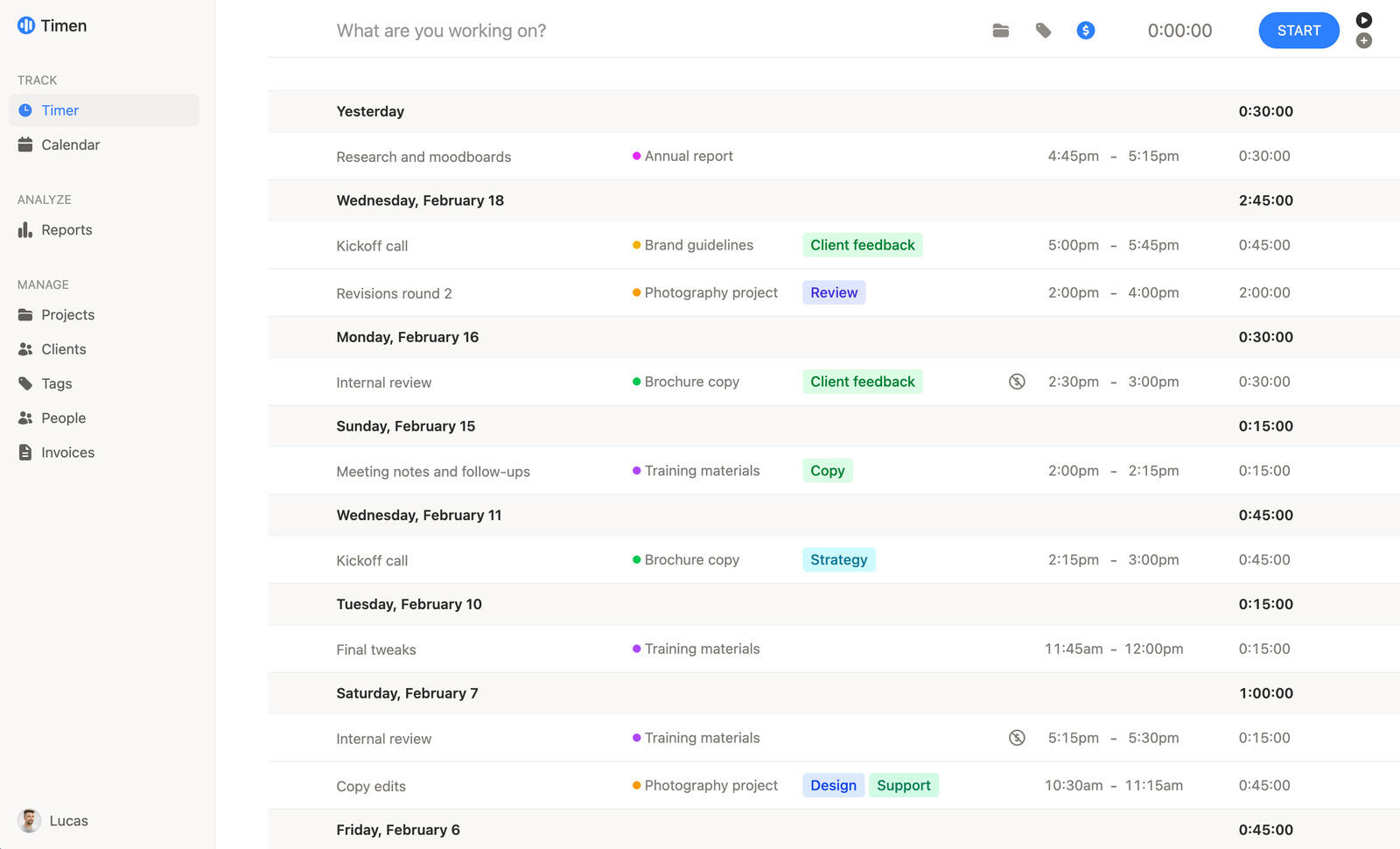
Timen is better for small teams that care about speed and clarity for the person logging time. Clockify is better for organizations that accept a busier interface because they want more flexibility and more settings behind the scenes.
This difference shows up fast in small client teams. A three-person consultancy will usually notice the product feel more than the admin features, because the same people tracking time are also checking a timesheet calendar and sending invoices. In that setup, Timen often feels cleaner. A twenty-person team with managers and different permission levels will feel the Clockify argument more clearly.
When do Clockify's admin controls matter more than Timen's simplicity?
Clockify is better for teams whose buying problem is operational control. If you need required fields, approvals, lock times, more permission structure, or a cheaper way to standardize time tracking across many people, Clockify has the stronger case.
Timen is better for teams whose buying problem is everyday follow-through. If your team mostly needs a tool people will happily use, then review time through reports and move into invoicing without extra layers, the calmer workflow tends to matter more than the additional settings.
That is why Clockify is usually a scaling choice and Timen is usually a simplicity choice.
How does pricing compare?
Both tools start free: Clockify offers a free plan for unlimited users, and Timen is completely free with every feature included. Timen is simpler once you decide you want a complete workflow instead of feature levels that unlock more controls over time.
| Pricing point | Timen | Clockify |
|---|---|---|
| Free plan / trial | Free for everyone | Free plan for unlimited users |
| Next pricing level | Free — all features included | Basic from $3.99 per seat/month billed annually, or $4.99 monthly |
| Upgrade trigger | None — every feature is already included for free | Moving into Standard or Pro for invoicing, approvals, and broader controls |
| Best budget fit | Teams that want everything for free with fewer compromises | Teams that want the lowest-cost entry and free rollout |
Since both tools are free to start, this decision is really about coverage versus better habits. If you want a free plan for unlimited users with deep admin controls as headcount grows, Clockify has the broader rollout story. If the team is small enough that workflow quality matters most, Timen is often the better fit — and it is completely free, with every feature included.
Strengths and tradeoffs
This is a clean contrast between a better workflow and a cheaper, broader rollout story.
Timen
- Cleaner everyday workflow for contributors.
- Calendar review, reports, and invoicing are already included.
- Completely free for everyone, so pricing is never a question.
Main tradeoff: Timen is the weaker fit if you need more admin controls, more granular policies, or a very low-cost rollout across a bigger team.
Clockify
- Excellent free starting point for teams.
- Lower paid entry than most established competitors.
- Broader operational controls as needs grow.
Main tradeoff: Clockify is the weaker fit if you want the product to feel calmer and more complete for contributors instead of more configurable for admins.
Common questions about Timen vs Clockify
These are the buying questions that usually decide this matchup.
- Is Timen better than Clockify?
- Timen is better for a calmer all-in-one workflow. Clockify is better for budget-focused teams that want free rollout and stronger admin controls.
- Which tool is easier to use, Timen or Clockify?
- Timen is easier for contributors using it every day. Clockify is easier for budget-conscious organizations that care more about control and coverage than interface polish.
- Which tool is cheaper, Timen or Clockify?
- Both start free: Clockify has a free plan for unlimited users, and Timen is completely free with every feature included. Timen is simpler to evaluate because it does not hide core workflow features behind multiple upgrades.
- Should a growing team choose Timen or Clockify?
- Choose Clockify if scale and admin structure are the main priorities. Choose Timen if the team is still small enough that workflow quality will matter more than the extra controls.
Final decision
Choose Timen if you want time tracking to stay simple without feeling bare. Choose Clockify if free rollout, lower seat cost, and broader controls matter more than the product feel. The better tool depends on whether you are buying for cleaner habits or for cheaper coverage.
If you want to keep comparing inside the Timen cluster, start with Timen vs Toggl Track, look at the billing-heavy tradeoff in Timen vs Harvest, or see how Timen's reports keep weekly review short.
Try Timen if your team wants fewer settings, fewer handoffs, and a cleaner weekly routine around tracked time.