












Timen vs Toggl Track: which tool is better?
Choose Timen if you want the better all-in-one workflow for tracking, review, reporting, and invoicing. Choose Toggl Track if you want a pure timer-first tool with a very familiar workflow and a stronger free starting point.
Timen and Toggl Track are close in one important way: both keep time tracking direct enough that people will actually use them. The real difference is what happens after the timer stops. Timen gives you more built-in context around the logged time, while Toggl's time tracker stays closer to a classic timer and reporting tool.
That means Timen is usually the better fit when a freelancer, consultant, or small client team wants a simple timer plus fewer moving parts. Toggl Track is usually the better fit when the team wants the cleanest timer habit possible and already knows it can live with a lighter billing and review workflow.
Which is better: Timen or Toggl Track?
Timen is better for freelancers and small client teams that want tracked time to flow into review, reporting, and invoicing in the same product. Toggl Track is better for teams that mostly want a proven timer-first workflow and care more about logging time fast than what happens after.
Choose Timen if you want the fuller workflow. Choose Toggl Track if you want the cleaner pure tracker and a stronger free starting path.
Quick decision
Choose Timen if:
- You want time tracking, calendar review, reports, and invoicing in one product.
- You want contributors to log time simply, then review it with more context later.
- You prefer completely free access with every feature included.
Choose Toggl Track if:
- You want the most familiar timer-first workflow with the least day-one friction.
- You want a free option for up to three users while you test a timer-first workflow.
- You care more about broad integrations and an established timer habit than built-in invoicing.
Biggest difference: Toggl Track is the cleaner pure tracker, while Timen gives you a broader time-to-review-to-invoice workflow without becoming heavy.
At a glance: Timen vs Toggl Track
Use this table if you want the fastest read on where the products separate in practice.
| Category | Timen | Toggl Track |
|---|---|---|
| Best for | Small teams and freelancers who want a fuller workflow without extra complexity | People and teams that want classic timer-first tracking |
| Core approach | Direct tracking plus calendar review, reports, and invoicing | Direct timer, timesheet, and reporting workflow |
| Main strength | More context around logged time without more tiers | Very familiar and easy daily tracking habit |
| Main tradeoff | Smaller ecosystem than Toggl Track | Less built-in follow-through after time is logged |
| Better fit | Client work that needs review and invoice readiness | Teams that mainly want a proven timer and reports |
Which tool is easier to use every day?
Timen is better for teams that need the work after the timer to stay simple. Toggl Track is better for teams whose whole goal is starting a timer, stopping it, and moving on.
That sounds like a small difference, but it changes the product feel. Toggl's time tracker is optimized for immediate entry and minimal decision making. Timen stays direct too, but it gives the tracked time more structure once it exists, which saves context switching later.
A consultant who logs time across calls, email, and focused project work will usually notice that difference quickly. In Toggl, the workflow stays cleaner in the moment. In Timen, the follow-up review tends to feel less fragmented once the week is over.
Do you need more context after the timer stops?
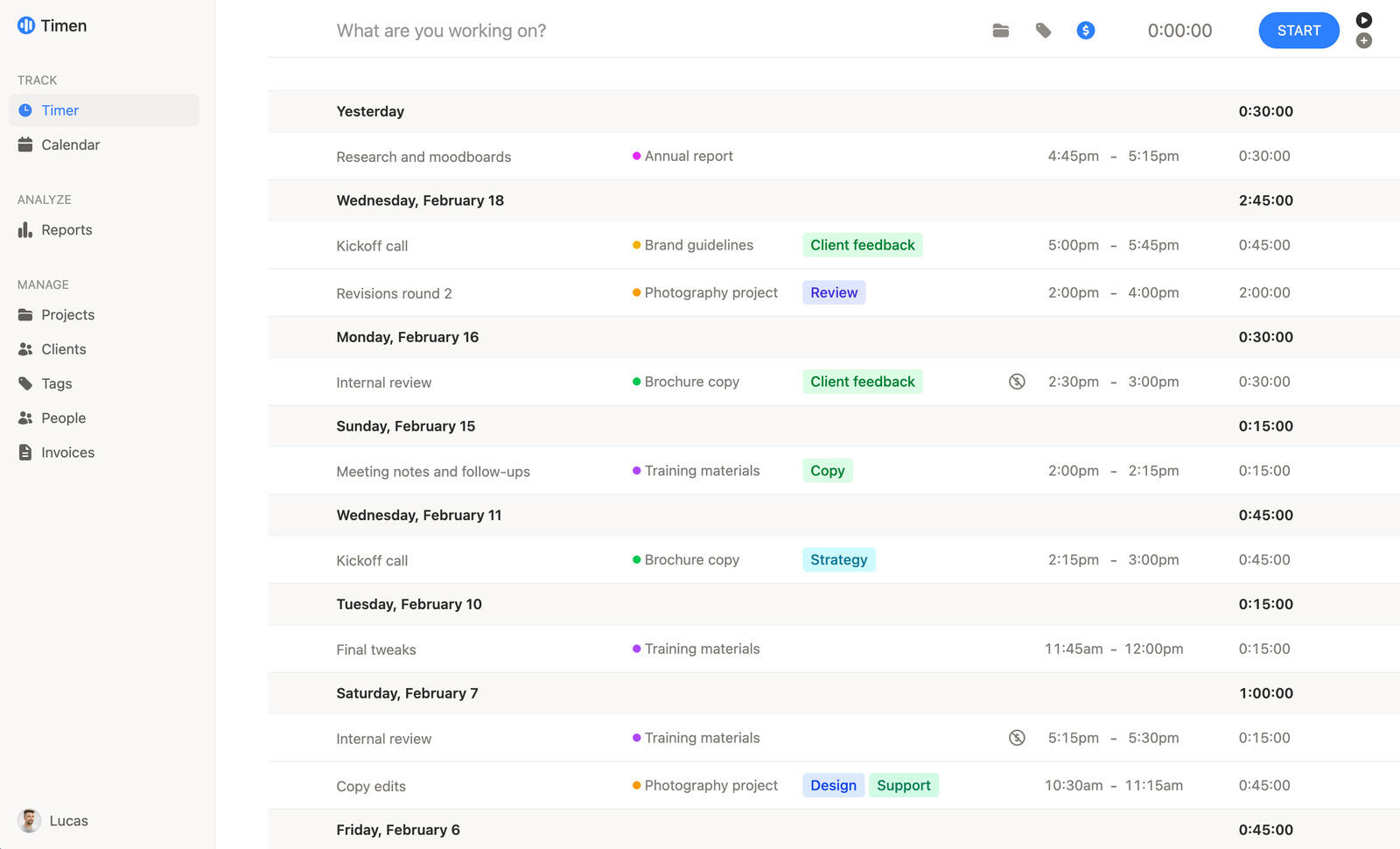
Timen is better for teams that do something with their time data after logging it. Its calendar review and built-in invoicing make more sense when the timer is only the start of the workflow.
Toggl Track is better for teams that mainly want a clean tracker with established reporting. But its main strength is not turning tracked hours into a calmer end-to-end routine the way Timen's reports support a client-facing team.
Who should pick Timen and who should pick Toggl Track?
Timen is better for freelancers, consultancies, and small teams that want one product to carry them from time entry through review and invoicing. Toggl Track is better for broader teams that want a neutral time tracker they can fit into an existing stack.
This is also where company habits matter. Teams that are already comfortable adding separate tools for invoices, project billing, or client follow-up will often prefer Toggl Track. Teams that want fewer decisions and fewer handoffs usually lean toward Timen.
The practical test is simple: if your team says "we just need a great timer," the Toggl app is hard to argue with. If your team says "we need time tracking to finish the job," Timen is the more complete fit.
How does pricing compare?
Toggl's combined product is free for up to three users. Timen is free with no user cap and includes reports and invoicing from tracked hours. If you already use Toggl Track, check your existing workspace terms separately.
| Pricing point | Timen | Toggl Track |
|---|---|---|
| Free plan / trial | Free for everyone | Free for up to 5 users |
| Next pricing level | Free — all features included | Starter from $9 per user/month, or $10 billed monthly |
| Upgrade trigger | None — every feature is already included for free | Needing Premium reporting, approvals, or enterprise controls |
| Best budget fit | Teams that want everything free and fewer tool handoffs | Teams that want the cheapest credible starting path |
Choose around the work your team needs to do. Toggl may suit you if its integrations are essential. Timen is worth considering if you want tracking, reports and invoices together without a per-user subscription.
Strengths and tradeoffs
This matchup is not about one tool being universally better. It is about whether your team wants the cleaner pure tracker or the broader workflow around the tracked hours.
Timen
- Simple time tracking that does not stop at the timer.
- Calendar review gives logged time more usable context.
- Reports and invoicing are already part of the same product.
Main tradeoff: Timen is the weaker fit if your team mostly wants a very established timer product with a larger ecosystem and no interest in built-in invoicing.
Toggl Track
- Very easy to learn and easy to keep using.
- Strong free starting point for small teams.
- Broadly trusted timer-first workflow with good reporting.
Main tradeoff: Toggl Track is the weaker fit if your team wants logged time to move smoothly into review, billing, and invoices without stitching together extra tools.
Common questions about Timen vs Toggl Track
These are the questions that usually matter most when someone is down to Timen and Toggl Track.
- Is Timen better than Toggl Track?
- Timen is better when you want a fuller time workflow in one product. Toggl Track is better when you want the cleanest timer-first experience and a bigger free on-ramp.
- Which tool is easier to use, Timen or Toggl Track?
- Toggl Track is slightly easier for pure timer use. Timen becomes easier if the team also needs calendar review, reports, and invoicing without extra setup.
- Which tool is cheaper, Timen or Toggl Track?
- Toggl is free to start for up to three users. Timen is completely free, with every feature already included.
- Should a freelancer choose Timen or Toggl Track?
- Choose Timen if the freelancer wants to track time and invoice from the same workflow. Choose Toggl Track if the freelancer only wants a clean timer and does not mind keeping billing elsewhere.
Final decision
Pick Timen if you want a simple product that carries tracked time further. Pick Toggl Track if you want the best-known timer-first workflow and the lower-friction free starting path. The better tool depends on whether you are optimizing for pure tracking or for what comes next.
If you want more context before deciding, compare Timen vs Clockify, see how the billing tradeoff changes in Timen vs Harvest, or look at Timen's calendar review workflow.
Try Timen if you want to see whether a slightly broader workflow feels calmer than a pure timer in everyday use.