













Toggl pricing in 2026: what each plan costs and what is still free

Toggl Starter costs $9 per user per month and Premium costs $16 when billed annually, or $12 and $24 on monthly billing. Enterprise has custom pricing. The combined Toggl product includes time tracking and planning, with a free plan for up to 3 users. If you already use Toggl Track, check your workspace terms separately from the new public plans.
What does Toggl cost in 2026?
Toggl has four plans: Free, Starter, Premium and Enterprise. The table shows monthly costs per user. Annual billing requires a yearly commitment.
| Plan | Annual billing | Monthly billing | What it adds |
|---|---|---|---|
| Free | $0 | $0 | Timers, focus mode, calendar integrations, tasks, boards, task estimates, personal reports. Up to 3 users |
| Starter | $9 per user | $12 per user | Billable rates, timeline views, tags, milestones, team reports, PTO and public holidays, flexible hours |
| Premium | $16 per user | $24 per user | Labour costs and profitability, fixed-fee projects, project dashboards, timesheet approvals, Jira and Asana, SSO |
| Enterprise | Quoted | Quoted | Custom roles, dedicated support and onboarding, custom integrations |
Annual billing saves 25 percent on Starter and about 33 percent on Premium compared with paying monthly. Choose it when you are confident the plan fits. Also consider the highest-tier feature your team needs: if the workspace requires Premium for timesheet approvals, budget for the whole team at that level.
A team of five pays the equivalent of $45 a month on Starter with annual billing, or $60 on monthly billing. Premium costs $80 or $120. On the combined product, adding a fourth person means paying for all four users, not just the additional seat.
What changed: Toggl Track and Toggl Plan are now one product
Toggl previously offered Track for time tracking and Plan for planning and capacity management. The current Toggl pricing page combines those features in one product.
The public plans do not establish what happens to every existing Track account. Check your workspace terms before assuming a change to your renewal or free allowance. The Toggl product changes also affect what new teams should compare.
Even Free now includes tasks, boards and task estimates. Starter adds timelines and milestones. When comparing Toggl with a simpler tracker, consider whether you will use those planning features.
Is Toggl still free?
Yes. The combined Toggl has a free plan for up to 3 people, with no credit card required. It includes timers, focus mode, calendar integrations and personal reports, plus tasks, boards and task estimates.
The three-user limit appears in Toggl's pricing FAQ. A new team of four or five needs Starter, costing $36 to $45 a month on annual billing. Existing Track users should check their own workspace terms rather than assume the new limit applies to them.
New workspaces also receive a 30-day trial of paid features. Keep that in mind while evaluating the product: features you use during the trial may require a subscription afterwards.
What does the free plan leave out?
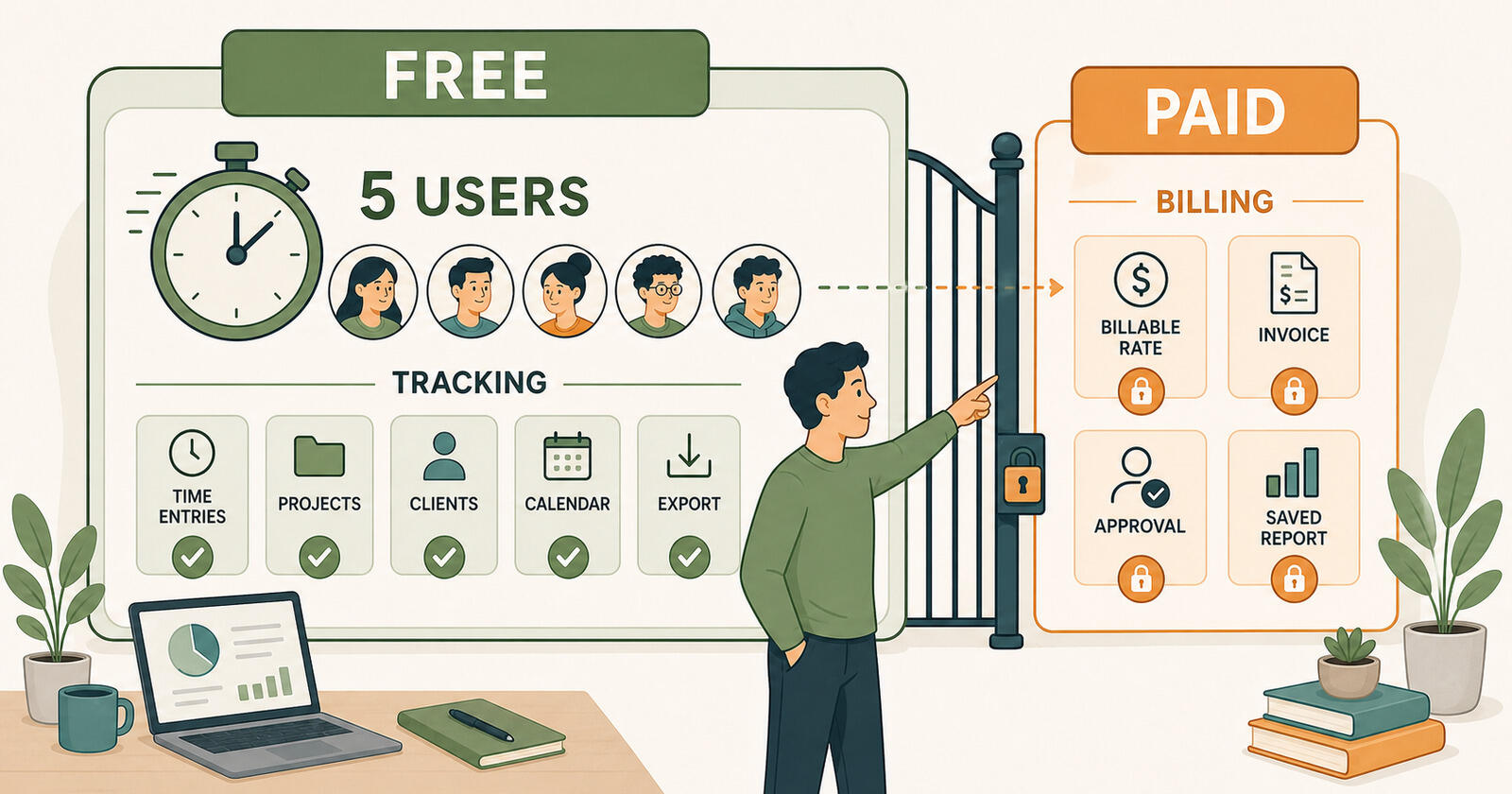
The main limits are billing, team reporting and spreadsheet exports. You can record four hours on a client project for free, but attaching a billable rate or exporting those hours as a spreadsheet requires Starter.
| Feature | Free | First plan that has it |
|---|---|---|
| Team size | Up to 3 users | Starter for the fourth person onwards |
| Timers, focus mode, calendar integrations | Included | Free |
| Tasks, boards, task estimates | Included | Free |
| Personal reports | Included | Free |
| Billable rates | Not included | Starter |
| Timeline views, tags, milestones | Not included | Starter |
| Team reports and team timeline | Not included | Starter |
| PTO, public holidays, flexible hours | Not included | Starter |
| CSV and Excel export | Not included | Starter |
| Labour costs and profitability reports | Not included | Premium |
| Fixed-fee projects, project dashboards | Not included | Premium |
| Timesheet approvals | Not included | Premium |
| Jira and Asana integrations, SSO | Not included | Premium |
The export line deserves its own sentence, because it is the one people discover last. On the free plan a report comes out as a PDF. Getting your hours out as CSV or Excel, so you can total them in a spreadsheet or move them anywhere else, is a Starter feature. A PDF is a document and a CSV is data, and if your invoicing starts by exporting hours, the free plan stops working at the first invoice rather than at the fourth user. The Toggl export routes and their limits are covered separately, including the one that does not need a paid plan.
Which Toggl plan do you actually need?
Choose the lowest plan that includes the features your whole workspace needs.
- Free: up to three people who track time to understand it rather than to charge for it, and who are happy to read that time inside Toggl. Solo freelancers on fixed-fee work and small teams checking where the week went are well served.
- Starter: the plan most small teams that bill clients end up on. It adds the rate, the timeline, the tags and the team reports, and the CSV export. If you have four or more people, you are here whether you wanted the features or not.
- Premium: for the person who needs to approve timesheets before they become billable, or the owner who wants profitability by project. Labour costs, fixed-fee projects and the Jira and Asana integrations are the other reasons. It is $7 more per user than Starter, which on a team of ten is $840 a year, so it is worth being sure someone will use those features.
- Enterprise: For teams that need custom roles, integrations or dedicated onboarding and support. Discuss those requirements before requesting a quote.
You do not need Starter just to list tasks beside your timer. Free already includes tasks, boards and estimates. Upgrade for specific features such as timelines, milestones, billable rates or team reports.
How does Toggl's pricing compare?
Toggl's paid prices sit in the middle of the market and its free cap is now at the tight end of it. Clockify's free plan is capped at 5 users, and its paid tiers start lower; Harvest starts at a similar per-seat price to Starter and includes invoicing at that level, which Toggl does not; Jibble keeps unlimited free users but is an attendance tool rather than a billing one. If you want the two-way comparison, Toggl and Clockify is the one most teams are actually choosing between.
Compare both the user limit and the billing features. A free plan may cover your team size but still require an upgrade when you need billable rates or spreadsheet exports.
Timen takes the opposite approach and includes billable hours, invoicing and reports in the free product, with no user cap and no tiers. That is a different trade rather than a strictly better one: there is no capacity planning, no timesheet approvals and no Jira integration. If your reason for tracking time is to bill for it, the trade tends to favour you. If you wanted the planning half of the new Toggl, it does not.
How to tell whether the free plan covers your work
Test the full cycle you expect to repeat. For a solo consultant, that might mean recording a week of work, correcting an entry and preparing the breakdown a client wants. For a small team, it may also mean reviewing several people's hours together. The timer working well is only the first part of that test.
Write down the format you need at the end. A PDF you can send to someone and a spreadsheet you can analyse are different requirements. If you need to group, combine or recalculate the data elsewhere, check that export before deciding the free plan is sufficient.
Keep trial access separate from permanent free access. During a paid-feature trial, a report or setting may be available even though it is not included in the plan you intend to keep. Compare the result with the plan description and test again under the intended access level if needed.
Finally, plan for the next person joining. A three-person team that expects to add a fourth soon should compare the paid total now. That does not mean upgrading early; it means knowing whether the tool still fits when the free allowance no longer covers the team.
What to consider before choosing
Toggl's free plan suits up to three people who need time tracking and basic planning. Starter adds billable rates, team reports and spreadsheet exports; Premium adds approvals, profitability and workload reporting. New teams of four or more need a paid plan.
Before subscribing, test a typical week of work and the report or export you need at the end of it. That is a better way to choose a plan than judging the timer alone.
If you need tracking and invoicing without a subscription, Timen is free with no user cap.